Some tips and tutorials to better draw or paint a life model
See here photos of models posing for artists.
See here tutorials collected via the internet archives in "open source".
Proportions
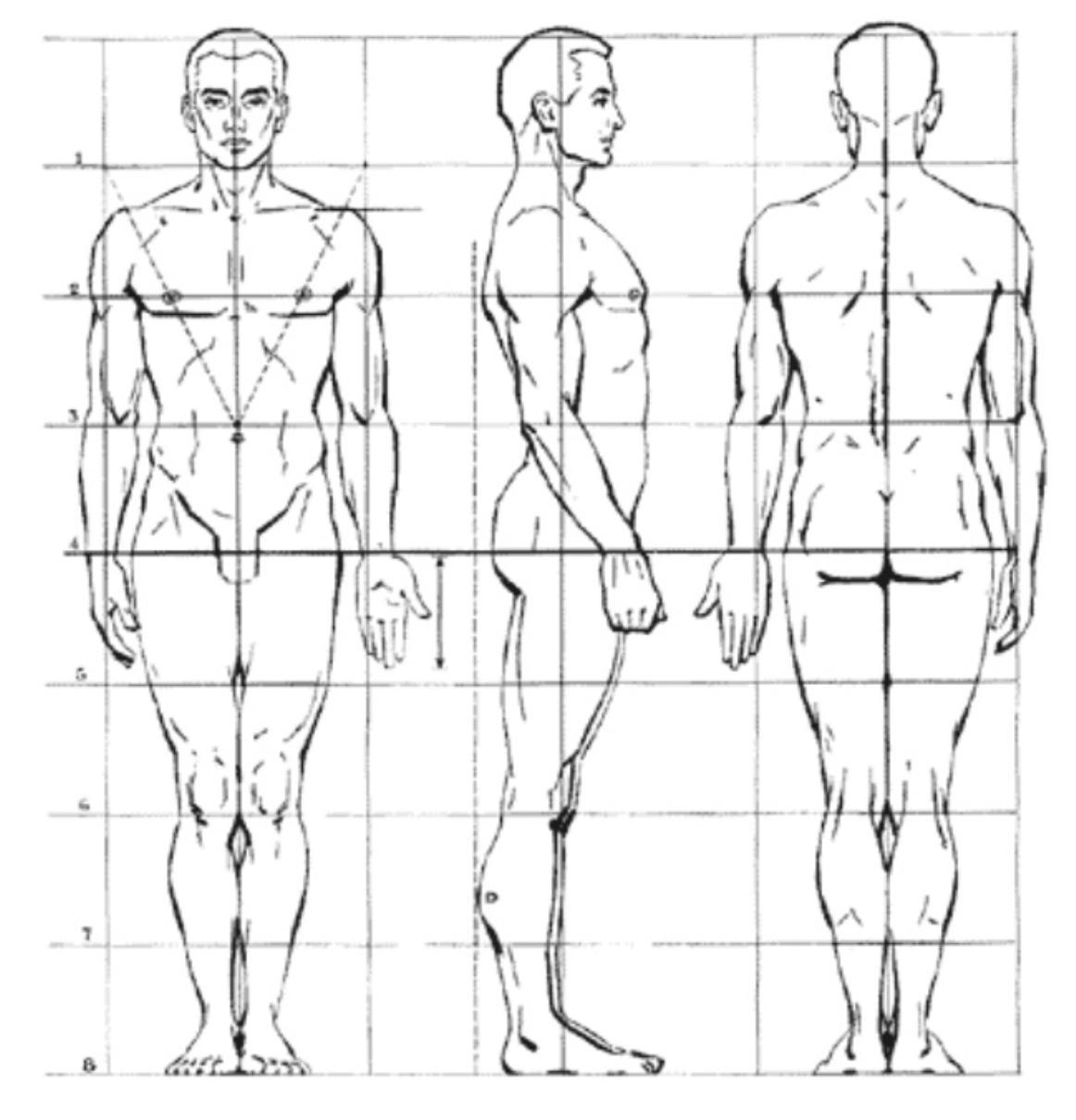
Male proportions
This is a necessary step for beginners, but it is not an end in itself; it is simply a means.
Knowing the correct proportions and accurately representing the different parts of the body is not necessarily enough to create a good drawing, whether from a graphic, aesthetic, or expressive standpoint.
The proportions of the human body in drawing are based on a simple idea: everything is measured in head units. The height of the skull (from the chin to the top of the head, excluding hair) is taken as the unit of measurement, and the rest of the body is expressed in multiples of this unit. This is a convention, not a biological law—but it provides a very useful mental framework for checking a drawing that "doesn’t look right."
The classic academic reference is 7.5 heads for an average adult figure, but the "heroic" canon inherited from Polyclitus (the Doryphoros) goes up to 8 heads, and fashion illustration often works with 8 or 9. Leonardo, in his Vitruvian Man, relies on Vitruvius’s text and prefers 8 heads with outstretched arms inscribed within the square and the circle.
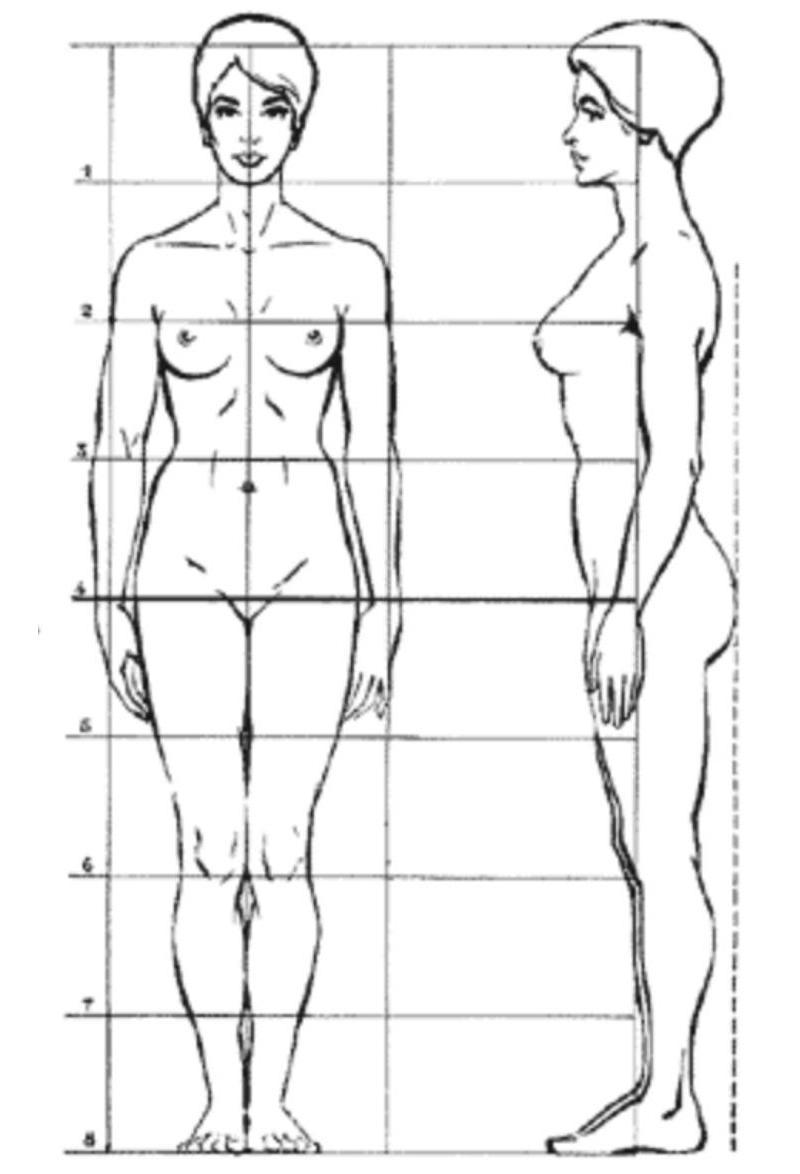
Female proportions
These figures are statistical averages across populations, with significant individual variations due to genetics, age, sex, and body type. Applying a rigid, mechanical standard results in "plastic" (lifeless/artificial-looking) figures. Skilled artists use such standards as a checklist, not as a template.
In practical terms: work from a life model whenever possible; use a plumb line or the edge of your paper to align reference points vertically; take measurements by comparison (the "extended pencil" method—using your thumb on a pencil to mark and transfer an observed length); and verify your proportions before moving on to details. When dealing with perspective or foreshortening, set aside the "head-unit" system and think in terms of volumes instead.
You can then choose to aim for a realistic representation—respecting the model’s actual proportions—or, conversely, to move away from realism, perhaps even distorting the body for graphic or aesthetic reasons. The key is that it remains a deliberate choice on your part.
Division of the body into eight equal parts.
- The center of the body aligns with the pubic area.
- The nipples align with the second module.
- The navel aligns with the third module, though it sits slightly below the bottom line of that module.
- The distance between the nipples is equal to the length of one head.
- The shoulder line aligns with subdivision A, located one-third of the way into the second module.
- The elbows are positioned roughly at waist level, slightly above the navel.
- The hand is one head-length long.
- The knee is situated above the sixth module.
- The calf (in profile view) extends beyond the vertical line established by the buttocks and shoulder blades. -* The wrists are positioned at the level of the pubic bone.
- The length of the arm, from the tip of the shoulder to the fingertips, measures a total of three and a half modules.
In children, everything changes
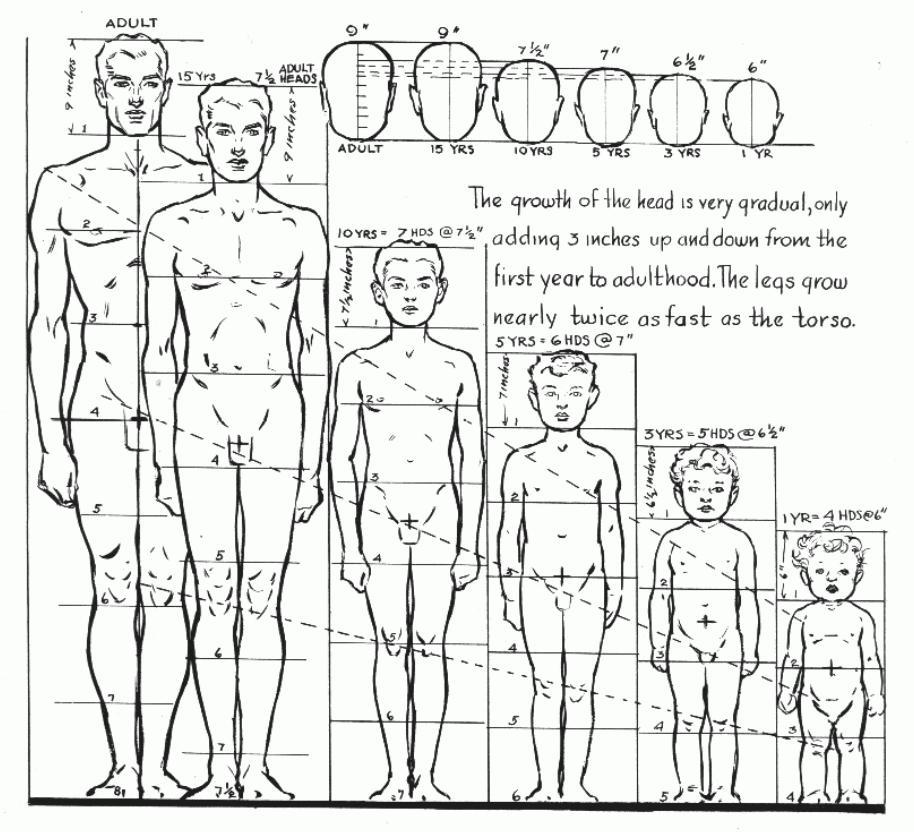
Children's proportions
The head-to-body ratio changes significantly during growth, as the head grows much more slowly than the rest of the body.
Therefore, a child should not be drawn simply as a smaller version of an adult; the legs must be shortened and the head enlarged in proportion.
| Age | Total height |
|---|---|
| Newborn | ≈ 4 heads |
| 2 years | ≈ 5 heads |
| 6 years | ≈ 6 heads |
| 10–12 years | ≈ 7 heads |
| Adult | 7.5 – 8 heads |
Comparative Morphological Topography of Men and Women
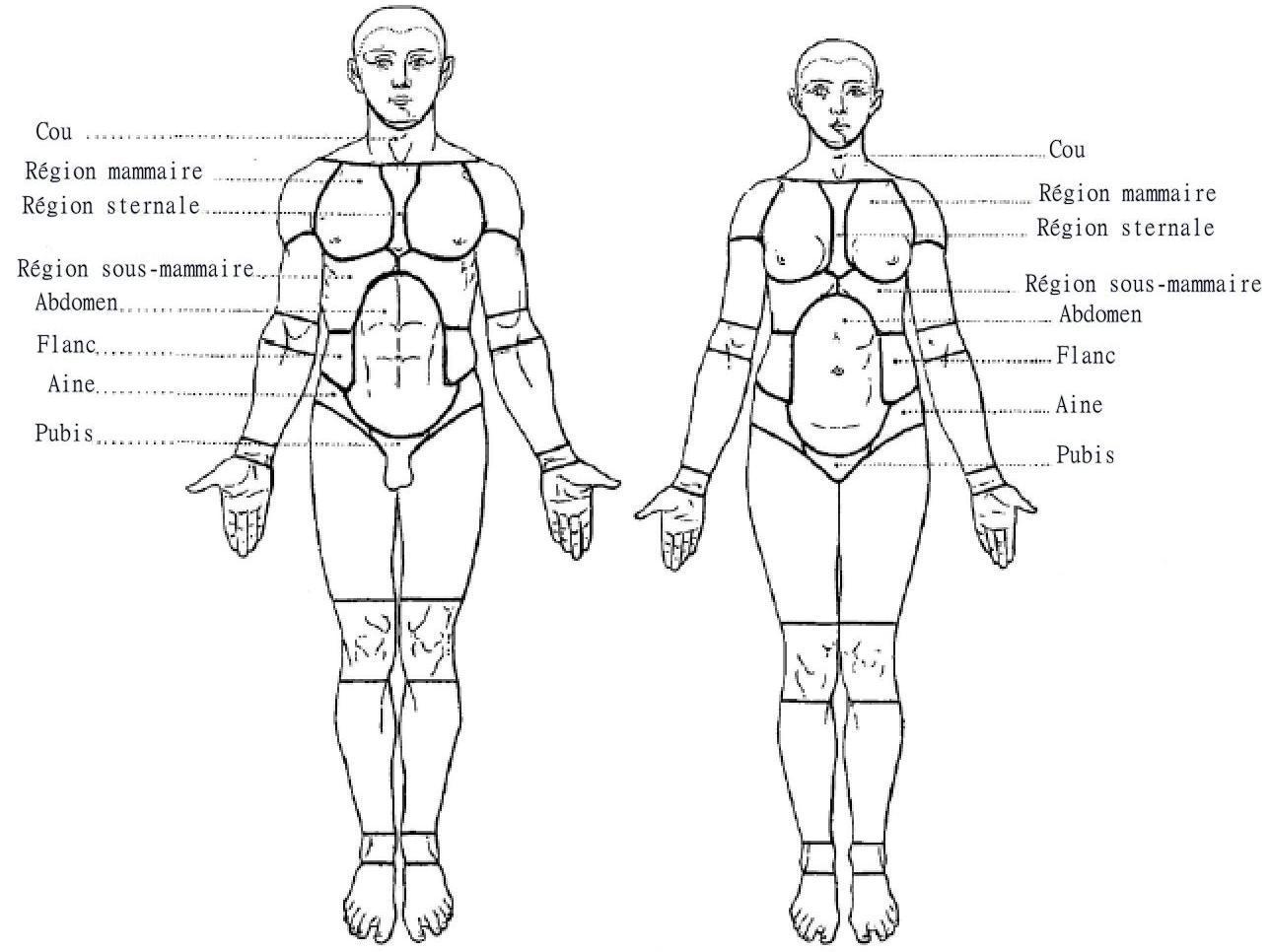
Front body
Morphological topography describes the shape of the body and the distribution of its primary structures. The differences presented here are general trends; they vary depending on the individual, age, origin, physical training, and hormonal characteristics. They cannot, on their own, be used to describe every single person.
The male skeleton is generally larger and more robust, with bulkier bones and more pronounced ridges where muscles attach.
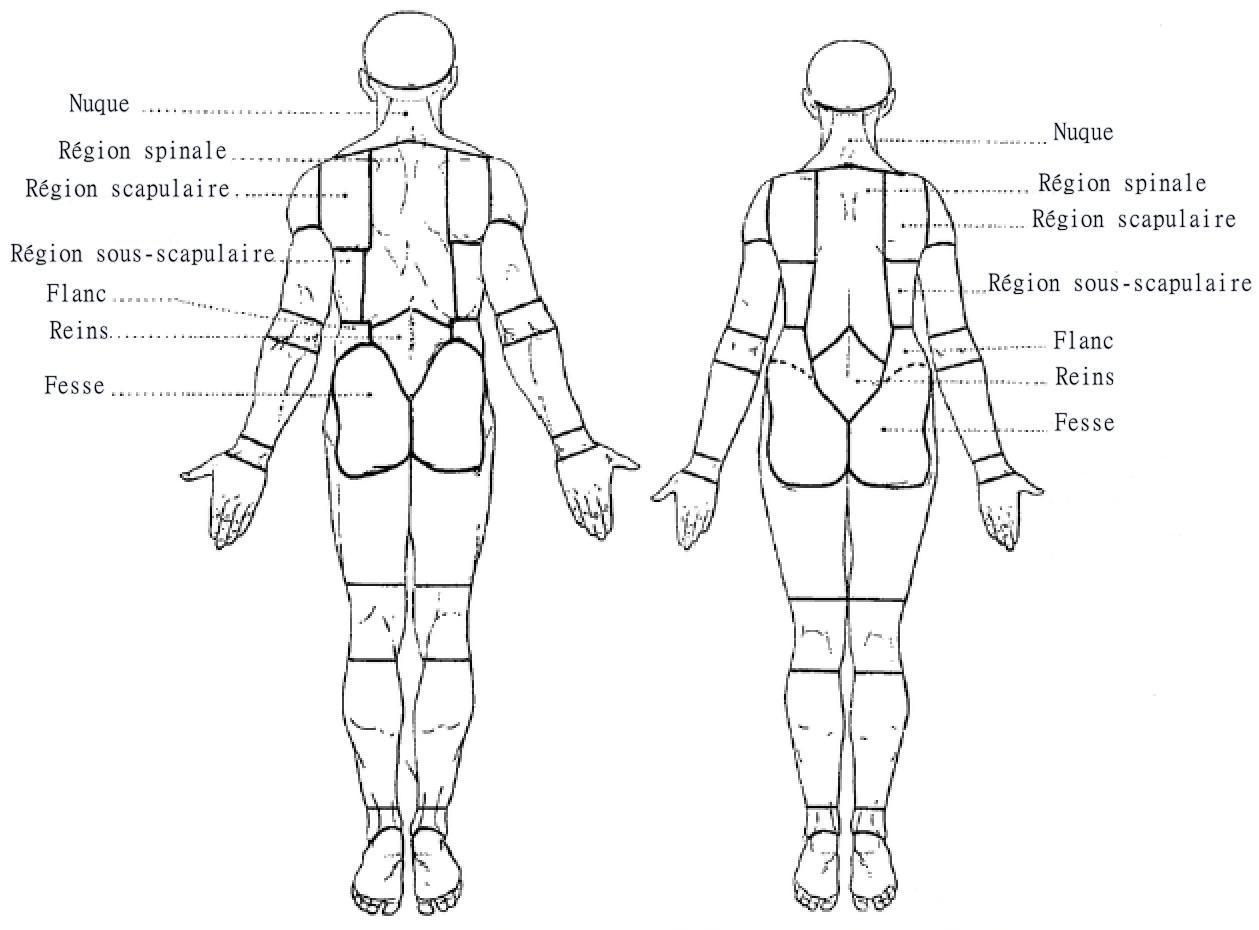
Back body
The female pelvis is, on average, wider in proportion to body size and exhibits differences in shape related, in particular, to pregnancy and childbirth. However, there is a great deal of anatomical diversity within both sexes.
Men generally have a greater total muscle mass, particularly in the upper body.
Women, on average, have a proportionally lower muscle mass and a different distribution of muscle volume.
Nevertheless, the primary anatomical differences concern the reproductive organs.
The Head
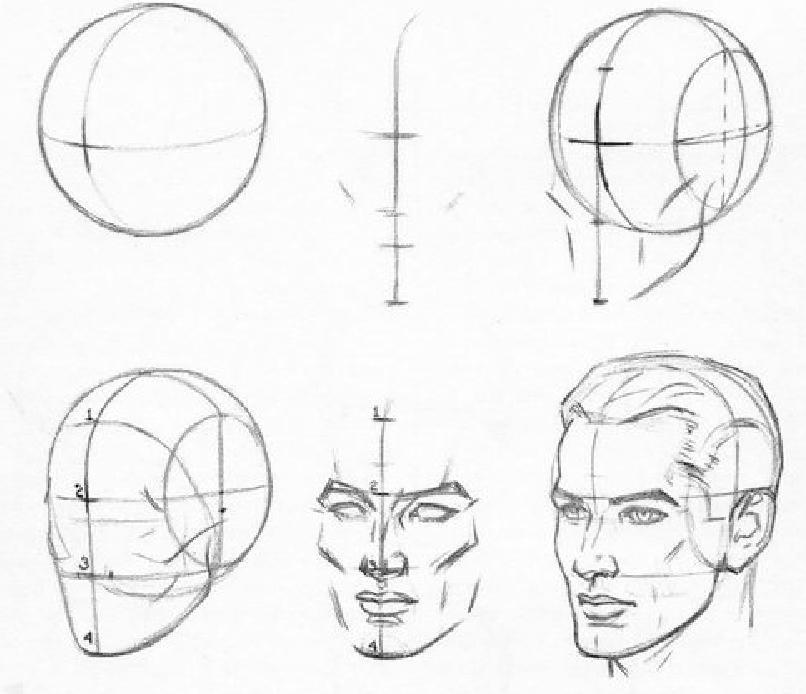
Head
Vertically, the head is divided into four roughly equal bands: crown to hairline, hairline to brow line, brow line to the base of the nose, and the base of the nose to the chin.
A counterintuitive but fundamental point is that the eyes are located at half the height of the skull—not in the upper third, as one might spontaneously tend to draw them. The mouth is positioned at approximately one-third of the distance between the base of the nose and the chin.
In terms of width, the head is about two-thirds of its height and spans the width of five eyes: one eye, a space equal to one eye, another eye, and then half an eye’s width on either side. The ear extends from the line of the eyebrows to the base of the nose.
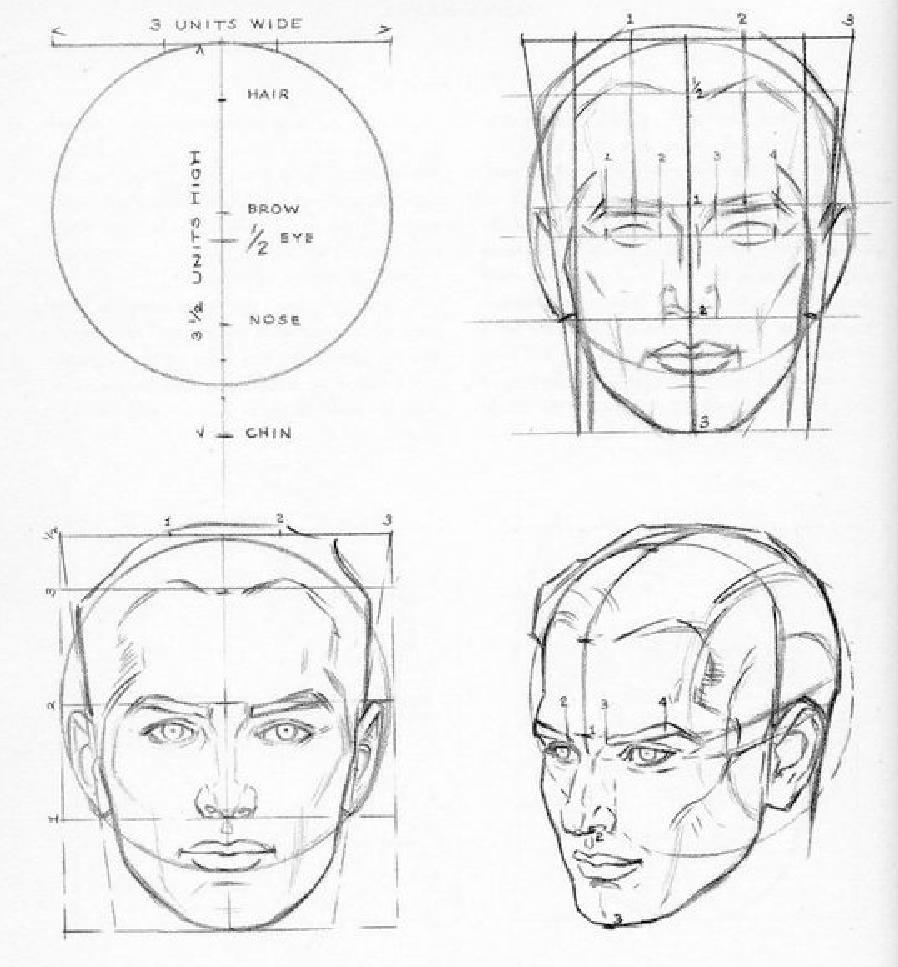
Proportions of a head
If you wish to delve deeper, the most frequently cited references are those of Andrew Loomis, whose method for constructing the head has become a standard.
